
Let's say your booth rent is $250 a week and it's due Tuesday. I worked with a booth renter in exactly that spot. She'd set aside the $250, routed it through an outside bank, and the week the transfer took days to land, her rent was late. Her split was fine. What broke was where the rent money sat and when it got there.
I've set up booth renters, barbers and two-partner salons on Sequence, and every setup starts the same way: the money that was never yours comes out first. For a booth renter like her, Mike Michalowicz's split runs next, and the first $250 out of operating expenses goes to rent, so it's waiting there days before Tuesday. The split itself works the way it does for any service business that runs Profit First on every deposit. What changes in a salon is everything around it.
What counts as salon revenue in Profit First?
Salon revenue in Profit First is what's left after you take out the money that was never the salon's. Mike Michalowicz builds a version of this into his method: before the percentages run, he subtracts materials and subcontractors from total revenue and calls what's left Real Revenue, the same adjustment contractors make for money that isn't theirs yet.
He walks through that adjustment on his own podcast, Profit First Nation, and Ronit Enos applies the whole method to salons in her book Profit First for Salons. Tips and sales tax go one step further, because they were never revenue to begin with.
In a salon, the money that was never yours comes in four kinds:
Money that was never yours | Booth renter | Salon owner |
|---|---|---|
What you paid for retail product you resell | Take it out | Take it out |
Sales tax on product sales, where your state charges it | Take it out | Take it out |
Card tips clients leave for your stylists | Your own tips are your income | Take it out until payroll pays them |
Your 1099 stylists' share, when clients pay the salon | Doesn't apply | Take it out |
Let's say a client's card payment comes to $162.37: a $120 cut, a $28 bottle of shampoo with $2.37 in sales tax, and a $12 tip for the stylist. The shampoo cost you $11.40. So the tip, the tax and the product cost come out first, and Profit First splits what's left. Don't do the math. The point is that about a sixth of that deposit was spoken for before it landed.

Product commission trips people up. A salon owner we onboarded had already opened eight bank accounts to run Profit First and still couldn't place the commission she earned on product sales: "I just don't know how to separate that commission." The commission is revenue, and the cost of the product is the part that comes out.
The cleanest way I've found to handle it is to give product sales their own income source. An income source is a feature in Sequence: an account with its own account and routing number, where a payout lands before anything gets split. With product sales landing in their own income source, the product cost comes out of product money and never touches the service split.
Everything else is revenue, including the booth rent your renters pay you. Rent is the one bill a salon can never be late on, so in both setups the rent money sits in its own account before the due date.
How should a booth renter set up Profit First?
A booth renter's setup runs in one order: payouts land in an income source, the split runs, and the first money out of operating expenses goes to rent. A barber I set up put it best: "I am the business." His business bills were his bills, and every dollar came from his chair, so there's no one else to catch a missed week.
Back to the booth renter from the top. She paid a barbershop owner $250 a week for her chair, and she wanted a second savings account she named "new salon," for the day she gets her own place. She'd moved her money over for one reason, in her words: "I don't want to see it in my [bank], because I'll start spending it." But her payouts still landed at that outside bank first, and her rules, the automations in Sequence that move money for her, pulled them over from there.
A pull from another bank takes 2 to 3 business days. So the week the rent money was still in transit on the due date, the rent was late, and she deleted every rule in a panic before we got on the call.
Here's the order we rebuilt it in:
Point your payouts at an income source. The money needs to land somewhere the split can run the moment it arrives. Point your card and booking-app payouts at an income source in front of the bank you already use, and the split runs as each payout lands.
Take out product cost. If you resell product, what it cost you comes out first.
Run the split. A percentage goes to taxes, to profit and to operating expenses, and owner pay gets the rest. The tax share is your call. She picked 10% herself. Many owners set aside 15 to 30% of each payment; ask your accountant what's right for you.
Pay rent first out of operating expenses. The first rule out of operating expenses sends a fixed $250 a week to a booth rent account, so there's always $250 there before the rest of operating expenses gets split up. Set it as a rule that transfers up to $250, and a light week still sends as much as it can. On the due date, a scheduled transfer moves the $250 to the account you pay your rent from.
Let the rest of operating expenses cover the other bills. Utilities, advertising and hair products. Give them their own accounts later, once you've watched a cycle or two.
Save for the new salon from owner pay. Out of what's left in owner pay, 15% goes to the new salon account every week, and the rest is hers to spend.
Let's say your week brings in $1,183.50, and you split it 10% to taxes, 10% to profit, 30% to operating expenses and 50% to owner pay. That's $355.05 into operating expenses. The first $250 goes to rent, and $105.05 is left for utilities, advertising and hair products. A slow week sends as much as it can, so you see a shortfall days before Tuesday. (Illustrative numbers.)

So you might ask, why a fixed $250 when everything else is a percentage? Because the rent doesn't change when your week does. A percentage sends more in a good week and less in a slow one. The booth rent is $250 either way, so I set it as a fixed amount and put it first. Moves between your Sequence accounts are instant, so the money is sitting in the rent account the moment it's sent.
How should a salon owner run Profit First with booth renters?
A salon owner fills the rent account before the split, because the lease is the one bill that has to be covered no matter how the week went.
Picture a salon with nine booth renters, each paying you a share of what they made. What comes in changes every week, and it drips in on different dates. Your own lease is due on the 1st. In one checking account, the balance looks great on Thursday and thin on the 30th, and you can't tell how you're supposed to pay the rent and still pay yourself.
This is the setup I walk salon owners through (numbers are illustrative):
Every renter pays into one income source. Renters pay by card or bank transfer to the income source's account and routing number, so every payment lands in the same place and counts as salon revenue.
The money that was never yours comes out first. Card tips, product cost and any share you collect for 1099 stylists.
Taxes come off as a percentage. The share is yours to set with your accountant.
The rent account fills from every payment until it holds the lease. Let's say your lease is $4,280 a month. Every time money comes in, the rent account tops up toward $4,280, and on the 1st a scheduled transfer moves it to the account your landlord is paid from. The rent account has its own account and routing number, so you always have enough to pay the rent.
A hair products account tops up to about $1,000. You're always buying more product, so it refills to the same level and stops there.
Then the split runs on what's left. Operating expenses, owner pay and profit, by percentage.

Look, this is where I bend Mike Michalowicz's order. In the book, every bill comes after the split. Percentages are the simplest way to divide money, and they're what you can run by hand every couple of weeks. A top-up is the step past that. The rent account takes exactly what it needs to reach the lease, then stops, so the rent never depends on how the percentages landed that week, and everything after it gets split the way the book says.
More than half of the salons on Sequence that keep separate accounts have one just for rent, and as many keep one for taxes.
If your stylists work on commission
Some salons pay stylists a cut of what they bring in instead of charging booth rent. If those stylists are 1099 contractors and clients pay the salon, their cut was never the salon's money and comes out before the split. If they're on your payroll, their commission is payroll, which lives in operating expenses.
Either way, the takings swing week to week. What I'd set up is a holding account that everything lands in first, with a scheduled transfer that pays out the same amount every two weeks. A big week tops up the holding account. A slow week draws it down, and the split still runs on a steady number. On the other side of the chair, a stylist paying a percentage can send 30% of each deposit into an account she pays the salon owner from, the moment it lands. I haven't seen a salon run that 30% rule yet, so treat it as a starting point.
How do salon partners pay themselves under Profit First?
Under Profit First, salon partners each get their own owner pay account, both filled by the same split. Two partners I spoke with, a barber and a hairstylist, ran their shop the way a lot of new salons do. Every dollar of revenue went into business checking. They paid themselves all of it, then sent the business back whatever it needed to keep operating. Everyone else in the shop was a 1099 contractor collecting their own money, so none of that touched the salon's account. Margins were slim, and they wanted to flip the order.
Flipping it is Profit First. The business takes its share first, and the partners get paid from the share the split sets aside for them. Let's say the owner pay share comes to $1,847.60 in a week. The rule sends $923.80 to each partner's account, and each of them pays their own bills from there, debt included.
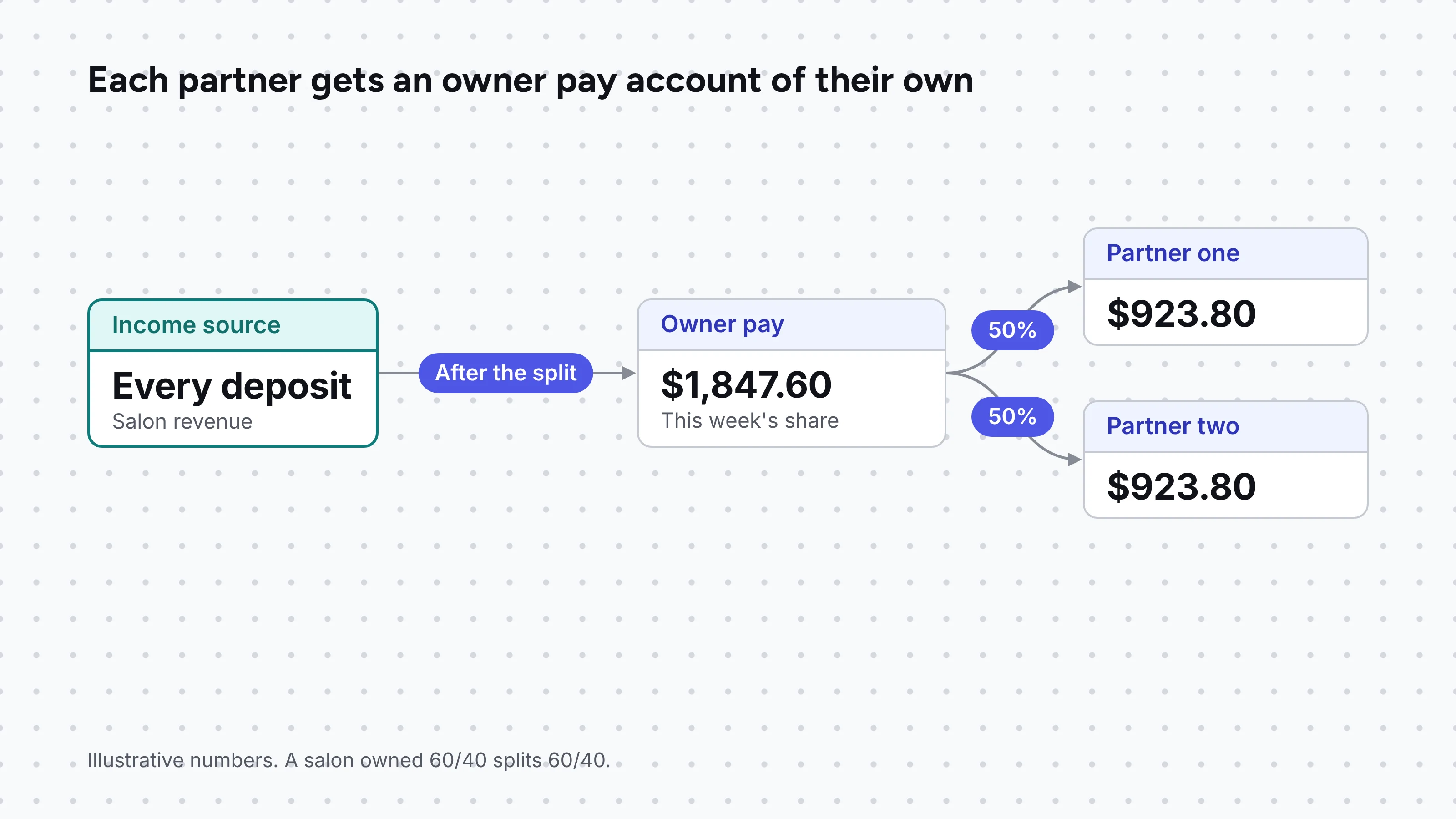
A shared owner pay account works fine until one partner needs more in a given month. Then it's a conversation every time. With two accounts, each partner sees exactly what's theirs, and nobody has to ask what the other one took. If you own the salon 60/40, the rule splits 60/40.
What if operating expenses can't cover the rent?
You'll see it before the due date. Let's say it's Monday, your $250 is due Tuesday, and the rent account holds $187.40. The rent rule sent what it could all week, and operating expenses still came up $62.60 short.
The tempting move is a rule that pulls the gap from profit or owner pay every week. I wouldn't build that in. It hides the problem inside the plan. A rent account that keeps coming up short is the business telling you something: your operating expenses are too big for what's coming in, and Mike Michalowicz's answer is to cut them until they fit.
So for this week, cover the gap with a one-time transfer and note it. That way it's a decision you made once, in the open, and profit stays untouched by any rule. Then watch a cycle or two. If the rent account keeps coming up short, look at what else draws on operating expenses and cut there first. And if the rent itself is too big for what you bring in, the fix sits in what you charge or what you pay for the chair.

What goes wrong in the first month?
Four things go wrong in a salon's first month on Profit First: too many accounts, rent on a percentage, rent through an outside bank, and moving money by hand.
Too many accounts comes first because it feels like progress. The booth renter from the top had built so many that nothing was filling up. What I always recommend in the beginning is to hold off on getting granular until you've watched the money flow through a cycle or two. Start with the split and a rent account. Add the rest once you know where the money actually goes.
Rent on a percentage looks fine in a good week and leaves you short in a slow one. A fixed amount or a top-up sends exactly what the rent needs.
Rent through an outside bank is how her rent ended up late. A pull from another bank takes 2 to 3 business days. Point your payouts at the income source instead, and the rent money is already inside your plan when it lands, where moves between your Sequence accounts are instant.

Moving money by hand is the one Profit First owners know best. The salon owner with eight accounts from earlier opened them at her bank to run the method, then hit the wall every hand-run setup hits: "It doesn't help me to have these eight accounts if I have to manually go into every single bucket."
Where should you start?
Start with one income source, the split and a rent account. Watch a cycle or two of money flow through, then adjust the percentages. You can change any rule whenever you want, and you can require approval before a move runs if you'd rather see a transfer before it happens. And if you want a second pair of eyes on your setup, that's what our onboarding calls are for.
FAQ
Is booth rent an operating expense in Profit First?
Yes, for a booth renter. The rent you pay for your chair comes from the operating expenses share after the split runs. For a salon owner, the booth rent your renters pay you is revenue.
Are card tips salon revenue?
No. Tips clients add for your stylists belong to the stylists. Take them out before the split and hold them until payroll pays them out. If you're a booth renter, your own tips are your income.
How much should a stylist set aside for taxes?
Ask your accountant what's right for you. Many owners set aside 15 to 30% of each payment, and the booth renter in this article chose 10% herself. Whatever percentage you pick, the plan moves it the moment money lands.
How many accounts does a salon need for Profit First?
Fewer than you'd think at the start. The split plus a rent account covers most salons in the first month. Add product, tips or goal accounts once you've watched a cycle or two.
Can I keep my current bank?
Yes. You connect the bank you already use (check yours on the supported institutions page). You point your payouts at an income source and keep everything else where it is.
How do I handle commission I earn on product sales?
The commission is revenue. The cost of the product you sold comes out before the split, and the cleanest way to do that is to give product sales their own income source.