You read Mike Michalowicz's Profit First, opened the accounts, and for a few months it worked. Then a busy month came along and the transfers on the 10th and 25th slipped. The tax money never made it to the tax account, and the next big bill came out of whatever was left in checking.
Whether you run a roofing crew or a dental practice, or anything in between, you didn't go into business to move $537.19 between four accounts every other Friday.
I've walked thousands of small business owners through their money, and the ones who come in for Profit First tell me some version of that story all the time. Mike Michalowicz got the core idea right. What breaks is the part the book leaves to you, which is moving the money by hand and fitting a whole business into four accounts.
Why does Profit First break down in a service business?
Profit First usually breaks down for one of two reasons.
The first reason is the obvious one. You have to do the split by hand, every time.
Most owners stall here because a service business gets paid all week. One owner we onboarded, who runs an appliance store with a repair business on the side, had opened the accounts years earlier, and tried to keep up with every deposit, but said they were "lacking the discipline to do it every day, especially for the service side." The book only asks you to split twice a month, on the 10th and 25th. But when payments land all week, each of those sessions means sorting through two weeks of deposits by hand, and one busy stretch is enough to skip it.

Banks can make it worse. Some cap how much you can move out in a day. One owner's bank stopped at $5,000, so a $7,000 tax transfer had to go out over two days.
Missing a session hurts too. Let's say you skip the 25th. By the 10th, a month of deposits has piled up, and you've already paid rent and payroll out of that pile. Now you have to work out what your tax share should have been on money that's partly spent, then move whatever's left.
The second reason gets talked about less. The book gives you four accounts: profit, owner's pay, taxes and operating expenses. Operating expenses alone has to cover almost every bill the business pays, from payroll to rent, and one account can't keep those bills apart.
Let's say you run a roofing company with a three-person crew. Crew pay, materials, insurance, the truck payment and your software subscriptions all sit in one "operating expenses" account. Payroll goes out every Friday, the supply house gets paid every time you pick up shingles, the $1,840 insurance premium leaves on the 1st and the $3,212.50 truck payment on the 15th. That one account can't tell you whether Friday's payroll is still covered after Tuesday's materials run. So a big materials week quietly eats into payroll, and you only find out on Friday. Four accounts can't hold a dozen bills that each come due on their own date and all draw from the same pile.

So what broke was the way Profit First is set up to run. The book asks a busy owner to do a bookkeeper's job twice a month, with four accounts that can't hold how a real business spends.
Sequence fixes both.
The split happens as money comes in, by rules you set, and you can give each bill its own account, a bucket of money set aside for that one job, so payroll has its money set aside before the supply house order ever touches it.
What happens to Profit First when you stop moving the money yourself?
The core of Profit First is that every dollar gets a job before you can spend it. Mike Michalowicz's book has deposits wait in an income account and get divided on the 10th and 25th.
That twice-a-month rhythm is on purpose. Michalowicz calls it the 10/25 Rule, two set days that turn the split into a habit. The book leaves the moving to you, and that's where most owners fall off.
In Sequence you set a rule once, an instruction like "send 15% of every payment to taxes on the 10th and 25th," and it makes those transfers without you sitting down to do them.
Some owners go a step further and split every payment as it lands. One even asked us on a call, "because it's all automated, why would you not do it instantaneously?"
In Sequence, splitting on arrival means a rule runs the moment a payment lands in your income source, and each share goes where it needs to go before anyone can spend it.
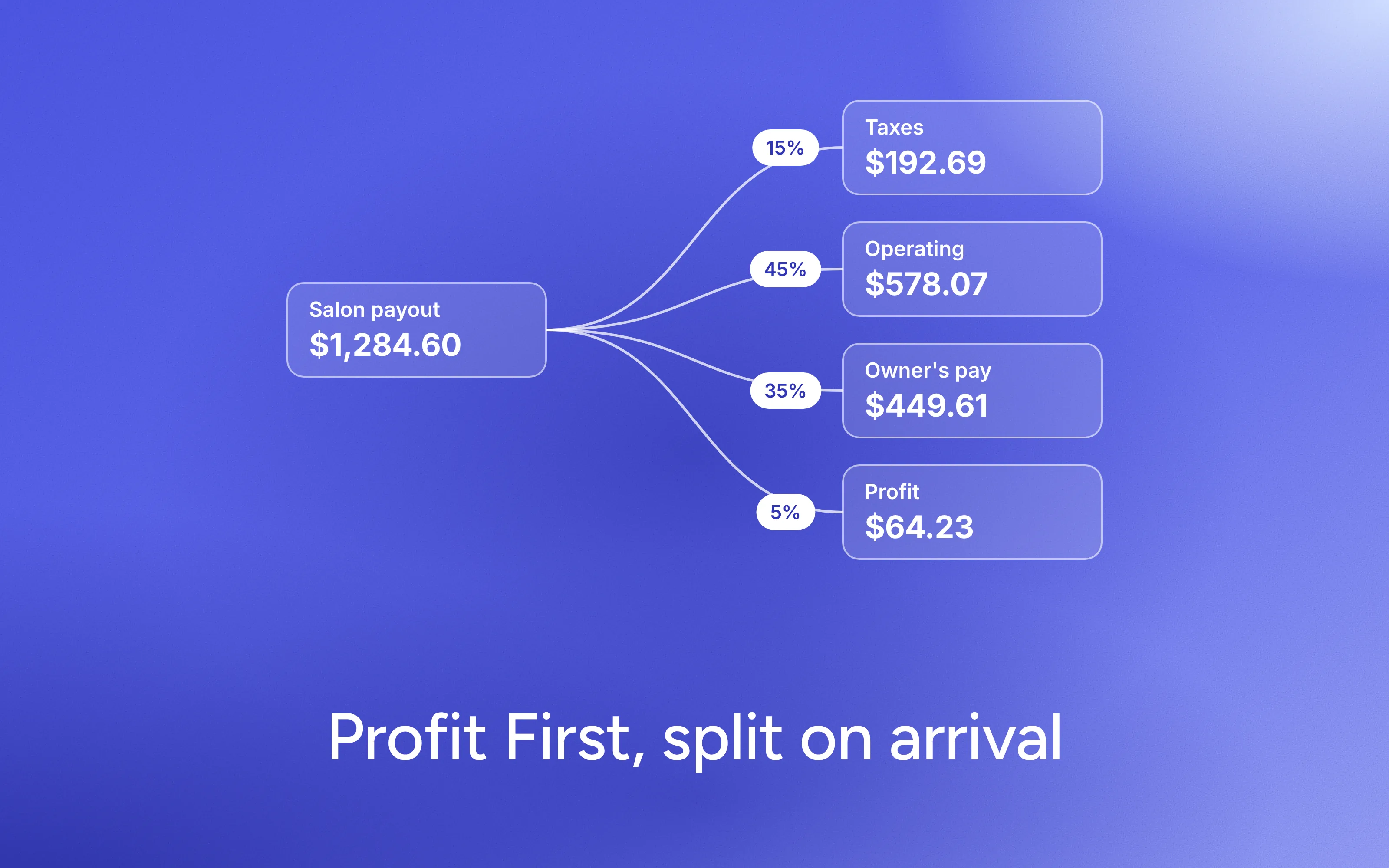
Let's say you own a small salon, and a $1,284.60 Square payout lands on a Tuesday. With an example split of 15% to taxes, 45% to operating expenses, 35% to owner's pay and 5% to profit, $192.69 goes to taxes, $578.07 to operating, $449.61 to you and $64.23 to profit.
Each share lands wherever you've set up that bucket. It can be an account you already have at your own bank, where it arrives the same day by ACH. Or it can be a Sequence pod, an account with its own account number and debit card, where it arrives instantly.
Those percentages are only an example, so pick yours with your accountant. You're doing the same exact thing you used to do on the 10th. You've just made it step one instead of step two. Once the split happens on arrival, your checking balance means something again. What's sitting there belongs there, so you can spend it without doing math in your head.

Plenty of owners tell me that they don't want their money sitting with a company they just found. It doesn't have to. None of your buckets have to be Sequence accounts, and they can all stay at your own bank. The income source isn't a place to keep money. Your rules send out everything that lands, so it keeps going back to zero, and the money reaches your accounts at your bank the same day by ACH.
How do you set up Profit First automation without changing banks?
You automate Profit First by putting one Sequence income source in front of the bank you already use. Every payment lands there first, and Sequence sends a set percentage of it to each of your Profit First accounts, either the moment it arrives or on the dates you pick. Each of those instructions is a rule, like "move 5% of every payment to profit." Your accounts, your checks and your bank relationship stay where they are.
Step 1: Put an income source at the door
An income source is a Sequence account with its own account and routing number where outside money lands. Picture a person standing at the door of your business. A $10,000 payment walks in, and before it goes anywhere else, that person decides: this much to taxes, this much to operating, this much to you. The income source is that person. Money only passes through it, on its way to the accounts you chose.

Step 2: Route the money in
Routing the money means pointing every payout you can at the income source: your Stripe, Square or Jobber payout, and client payments you invoice. For payers you can't move, leave them on your current account and add a rule that pulls from it. That pull takes 2 to 3 business days, so re-point whatever you can.

Step 3: Decide where the buckets live
The buckets can live at your bank or in Sequence. If you opened the accounts after reading the book, keep them and connect them. Most Profit First owners I work with do exactly that. Their four accounts stay at their bank, and an income source sits in front of them. If you never opened them, create the buckets in Sequence in a few clicks instead of filling out four bank applications. Each one is a real account with its own account and routing number.

Step 4: Set the order
The order decides what gets paid first, because each rule works on what's left after the one before it. Most owners I set up start with taxes, then operating expenses, and then work out owner's pay and profit from what's left. Put whatever can't be late at the top.

Should you split on every deposit or on the 10th and 25th?
There are three ways to time the split, and all three count as automated: every deposit, the 10th and 25th, or a weekly sweep.
Every deposit is what I recommend for most service businesses, because money arrives all week and the split keeps pace with it. Profit First Professionals advises against splitting more than once a week, since frequent transfers by hand make cash flow patterns hard to see. When Sequence does the moving, you can still read those patterns in each bucket's balance and in the activity record. If you split every deposit, the cleanest setup is to keep your buckets as Sequence pods, where moves between them are instant. If your buckets stay at your own bank, the 10th and 25th or a weekly sweep suits them better.
The 10th and 25th are the book's own rhythm, and they work well automated. Sequence moves the money on those dates, so the split happens whether you had a busy week or not. If you already run the 10th and 25th by hand, your rhythm stays exactly the same. You just stop doing the transfers yourself.
A weekly sweep sits in the middle. Every Monday, the week's money moves from your bank into the income source in one go, and the split runs from there.
What else can you automate beyond the percentages?
A percentage sends the same share of every deposit to the same place, no matter what's already sitting there. In Sequence you can also set rules that check an account's balance before they move anything. One rule can top an account up to a set amount. Another can take anything above a set amount and send it to a different account. Once the moves happen automatically, you start to see which accounts always run high and which keep running short. These are rules owners actually run.
A cap. You look at operating expenses and decide you never need more than $5,000 sitting there. So operating stops at $5,000, and anything above it sweeps to profit every week.
A split above a threshold. Two partners split everything above $300,000 a month 50/50.
A top-up first. A group therapy practice we set up takes 15% off the top for taxes, then tops payroll up to $40,000 before anything else gets split. The therapists get paid first, and owner's pay and profit only take a share once payroll is covered.
A cap with a remainder. A solo service owner using Sequence sends 15% of every invoice to taxes and keeps operating at about two months of baseline expenses, plus some padding. Everything above that goes to owner's pay.
Off the top. A real estate brokerage owner owes the franchise royalties of about 8% of every deposit. Before, that money sat in the main account, got spent on other bills, and the royalties fell behind. Now it leaves first, and the split runs on what remains.
One setup, start to finish
Back to the roofing company. Let's say a $4,812.40 payment for a finished job lands in your income source. Taxes take 15% first. Payroll already holds $6,240, so it tops up to $7,500 for Friday and stops there. Owner's pay takes 30% of what's left, profit takes 5%, and the rest goes to operating. Every Friday, anything in operating above $8,000 sweeps to profit.

Don't do the math. The point is that one deposit ran through five steps, in the order you set.
Which accounts do service owners add after the first four?
Owners build their buckets around their bills, and the book's four accounts are only the start. Among Sequence business accounts that use buckets, 49% set money aside for taxes. Bills come next: 29% keep a bucket for rent and 27% keep one for utilities and other bills, more than the 23% with an owner's pay bucket or the 20% with a profit bucket. About one in five keep an emergency buffer, 19% run a bucket for vehicles and fuel, another 19% run one for software, and payroll gets its own bucket in 15% of them.
The buckets tend to be the same handful:
Payroll, funded before payday.
Bill reserves for rent, insurance and anything due on a set date.
A buffer for slow weeks.
Money owed to others, like sales tax, subcontractors or booth rent.
Card payoff, so the statement is covered when it closes.
Giving, for owners who set aside a share of income for their church or a charity.
Each kind of service business adds its own on top:
Business | The account it adds |
|---|---|
Contractors and trades | Money that isn't yours yet: deposits, draws, permits |
Real estate investors | Each property paying its own mortgage first |
Salons and barbers | Booth rent and chair rent |
Therapists | Insurance that pays in batches |
Dental and chiro practices | Payroll, the practice loan and the lease |
Landscapers | A reserve that carries crews through winter |
Gyms and studios | A buffer for the summer dip in dues |
How fast does the money move, and who stays in charge?
Money moves at three speeds. Between your Sequence accounts it's instant. Out to another bank it goes same-day ACH, subject to that bank's cutoff. Pulled in from another bank, it takes 2 to 3 business days. The income source only passes the money through to where it needs to go.
You decide everything that moves. Most owners start their profit share small, because when you work out of one checking account there's this feeling that every dollar is tied up somewhere. What I always recommend is to watch a cycle or two of money flow through, then adjust the percentages.
You can also keep a person in the loop. One business run by two 50-50 partners holds its profit in one account all month. On the 25th that money moves to a profit account to be split between them, but only after one partner opens the rule, types in the exact amount and presses go. You can change any rule whenever you want.
How does Sequence compare with other ways to run Profit First?
Owners run Profit First four ways, and the differences come down to four questions:
System/Tool | Where the money lives | Who moves it | When it splits | What happens after the split |
|---|---|---|---|---|
Spreadsheet and manual transfers | Your bank | You | When you sit down to do it | Nothing until you do it again |
Neobank sub-accounts | The neobank, so you move your banking there | Rules inside that neobank | On the schedules that provider offers | Depends on the provider's rules |
Budgeting app | Wherever it already sits | You | It tracks spending | A report after you've spent |
Sequence | The bank you already use, plus Sequence accounts | Rules you set | As each deposit lands, or on a schedule | Top-ups, caps and sweeps, in your order |
Each of the other three handles one part of the job and leaves the rest to you.
A spreadsheet can work out the split. One owner came to us with a spreadsheet that already calculated every percentage, and they were still moving every dollar by hand.
A budgeting app shows where the money went, though only once it's spent, so it can tell you you're short without stopping it.
A neobank can hold your buckets and run its own rules, but only once your banking lives there, which is why some owners keep theirs and run Sequence across it.
What none of them does is split each payment as it lands at the bank you already use. Sequence does that part, and your bookkeeper still records where it all went in QuickBooks. Here's how Sequence works for service businesses.
Where to start
Start from the Profit First map with one rule on your income source. Watch a cycle or two, then add the next bucket. You'll know it's working when your checking balance only holds what belongs there. If you want a second pair of eyes on the setup, our team will walk through it with you.
FAQ
How do I automate Profit First?
Automating Profit First takes one income source that every payment lands in, plus rules that split each deposit into taxes, operating expenses, owner's pay and profit as it arrives. The rules can also run on the 10th and 25th or weekly. Your existing bank accounts can stay as they are.
How many accounts do I need for Profit First?
Profit First starts with four accounts: profit, owner's pay, taxes and operating expenses, plus an income account that feeds them. Most service owners add a few more over time, like payroll, bill reserves and a buffer.
Do I have to leave my bank or change where customers pay me?
No. Your bank stays. Point the payouts you can at the income source, and for payers you can't move, a rule pulls from your current account instead, with a 2 to 3 business day delay.
What percentages do service owners use?
Percentages vary by business, and owners usually tune them after a cycle or two. For taxes, ask your accountant what to set aside. The book calls current percentages CAPs and target percentages TAPs; owners on our calls just talk in plain percentages.
Is owner pay the same as profit?
No. Owner's pay is your salary for working in the business. Profit is what the business earns on top. One owner told us, "I was thinking that my owner pay was profit, but that makes sense that it's separate."
Does this replace QuickBooks or my bookkeeper?
No. QuickBooks and your bookkeeper record where money went. Sequence moves money where it needs to go as it arrives. You can add your bookkeeper as a viewer on your Sequence account.
Does Profit First work with irregular income?
Yes. Irregular income is where the hand version breaks first, because the amounts and dates keep changing. A rule divides each payment whatever its size, on arrival or on your set dates. A buffer account and a top-up rule smooth out the slow weeks.