
Let's say a homeowner sends your roofing company a $9,940 deposit on a re-roof that starts in three weeks. It lands in business checking next to last week's draws. On the 10th you run your Profit First split, and a share of that deposit goes to taxes, owner's pay and profit. Then the shingles come due, and the money that was supposed to buy them already paid you.
I see some version of this on contractor onboarding calls all the time. Look, Profit First works for contractors. But the split just has to run on money that's actually yours. Deposits, permit reimbursements and sales tax all land looking like revenue, so they come off the top first. What's left runs through the same automated Profit First split any service business uses.
Why does Profit First break for contractors?
For most contractors, Profit First breaks at the hand split. One GC we onboarded pulled payroll out of every deposit himself. The amount was never the same twice, because every draw is different. So every deposit meant a fresh round of math, on top of running the jobs.
Before the math even starts, you have to know what each deposit is. Is this the $9,940 re-roof deposit? A draw on a job you finished Friday? A homeowner paying you back for the permit? Each answer changes how much of it is safe to split.
When there's no time to sort, the split runs on all of it. That's how the re-roof deposit ended up paying your taxes, your pay and your profit before a single shingle went on. A lighting installer we onboarded described the same thing: "you just took someone's deposit... it's for the future."

Which money in a contractor's account isn't yours yet?
Four kinds of money land in a contractor's account before they're yours: customer deposits, pass-through money, sales tax, and the materials and subs share of each draw. Each one belongs in its own bucket, a separate account that holds money for one purpose until it goes where it belongs.

Customer deposits pay for work you haven't done yet. Until the job starts, that money belongs to the job.
Pass-through money is a client paying you back. A construction owner we onboarded put it simply: a $5,000 permit fee is the client paying him back, with no profit or overhead in it. Split it, and you've paid yourself a profit share on a city fee.
Sales tax belongs to the state from the moment you collect it. A family-run home services shop learned that the hard way: "We just got out of a major issue with the state comptroller because we owe back taxes for sales tax."
The materials and subs share of each draw is already owed to the supplier and the sub.
Sorting gets harder when one payment covers several jobs. A solar company we work with gets paid by its lender in one lump sum for four projects at a time. Nothing on that deposit says which job it's for.
Money | Whose it is | What a Profit First split does to it | Where it goes instead |
|---|---|---|---|
Customer deposit | The job, until work starts | Pays taxes, owner's pay and profit on work not done | A deposits bucket, until you bill against it |
Permit fee or reimbursement | The client paying you back | Takes a profit share out of a fee with no margin | Back to the account that paid it |
Sales tax | The state | Spends tax you already owe | A sales tax bucket |
Materials and subs | The supplier and the sub | Leaves the next materials run short | A materials bucket, topped up first |
How to set up Profit First for a contracting business
The setup takes what isn't yours off the top, then runs Profit First on what's left. It runs in five steps, in this order: keep deposits and reimbursements separate, take sales tax off the top, top up materials, run the Profit First split, and break operating expenses into the costs a crew actually has.

Step 1: Keep deposits and reimbursements separate
Picture a person standing at the door of your business, deciding where each dollar goes before anyone can spend it. That's an income source: a Sequence account with its own account and routing number, where payments land and your rules split them.
Most contractors need two. Final payments and draws land in the main income source. Deposits and pass-through money land in a second one.

You decide where each payment lands at the moment it goes in, because once two payments sit in the same account, a rule can't tell them apart. A painting company we onboarded keeps a separate project deposits account at its bank. The 50% upfront check on a new job goes into that account, the final payment check goes into the main one, and each account runs its own split.
A payer who pays electronically works the same way: give them the second income source's account and routing number for the deposit. If deposits come in through the same Jobber payout as everything else, the main income source can't tell them apart. Run its split on a schedule, such as the 10th and 25th, and move each deposit across with a one-time transfer before the split day.
The second income source also handles a lump sum from a lender. It lands and holds. You run a rule by hand, type in the amount for each job, and the earned part moves to the main one, where the split picks it up. What happens to a deposit after it lands is in the next section.
Step 2: Take sales tax off the top
Sales tax leaves first, into its own bucket. That way the income tax share in Step 4 never runs on money the state already owns.
How much to send is a question for your accountant, and the sales tax section below covers how owners keep it accurate.

Step 3: Top up materials first
Materials can't be late, so they go next. A mechanical shop we set up wanted its parts account filled back to $6,000 every time income came in, so we made that the first rule after the income source. A top-up only sends what's missing. If materials holds $4,812.40, the rule sends $1,187.60 and stops.

Step 4: Run the Profit First split
Now the split runs on money that's yours: taxes, payroll, owner's pay and profit. Payroll is the one contractors ask about, because crews are paid by the hour and draws swing.
Two rules handle it.
A percentage with a monthly cap sends, say, 30% of every payment to payroll and stops at $10,000. A top-up fills payroll to $10,000 but moves at most $1,500 at a time, so one big draw doesn't drain everything else.

Profit starts small. Construction businesses that keep a profit account send a median of 5.5% of every deposit to it, according to Sequence data. A roofer we onboarded said, "the objective would be to keep 5% as profit, but that's the goal." Set a share, watch a cycle or two, then adjust. If your work slows in winter, the landscapers guide covers a reserve that carries you through it.
Step 5: Break operating expenses into truck, maintenance and subscriptions
The book stops at one operating expenses account, and a roofing crew's costs don't fit in one. Split it three ways: truck and fuel, maintenance, and subscriptions. One home services owner we set up sends 5% of every payment to maintenance and another 5% to gas.
Among construction businesses that split income into buckets, 28% keep one just for vehicles and fuel, according to Sequence data. If you run several jobs at once, a debit card per job, paid from that job's own supply bucket and closed when the job ends, keeps those purchases apart.

One week, start to finish
Back to the roofing company. Let's say three payments land this week: the $9,940 re-roof deposit, a $1,180 permit reimbursement, and a $14,265.80 final payment on the job you finished Friday.
The deposit and the permit land in the second income source. The deposit waits in its bucket, and the permit money goes back to operating, which paid the fee. The final payment lands in the main one. Sales tax comes off the top, materials tops up, then taxes, payroll, owner's pay and profit take their shares, and the rest lands in truck, maintenance and subscriptions.

Of the $25,385.80 that landed, only the $14,265.80 final payment went through the split. The deposit and the permit money never touched it.
What happens to a deposit once the job starts?
A deposit sits in its own bucket until the work it pays for starts, and nothing gets split from it while it waits.
That wait ends when you bill against it. A remodel owner we onboarded takes deposits of $100,000 to $200,000 and invoices against them over the next two months, because none of that work is done when the money arrives. Each invoice is the moment part of the deposit becomes his.
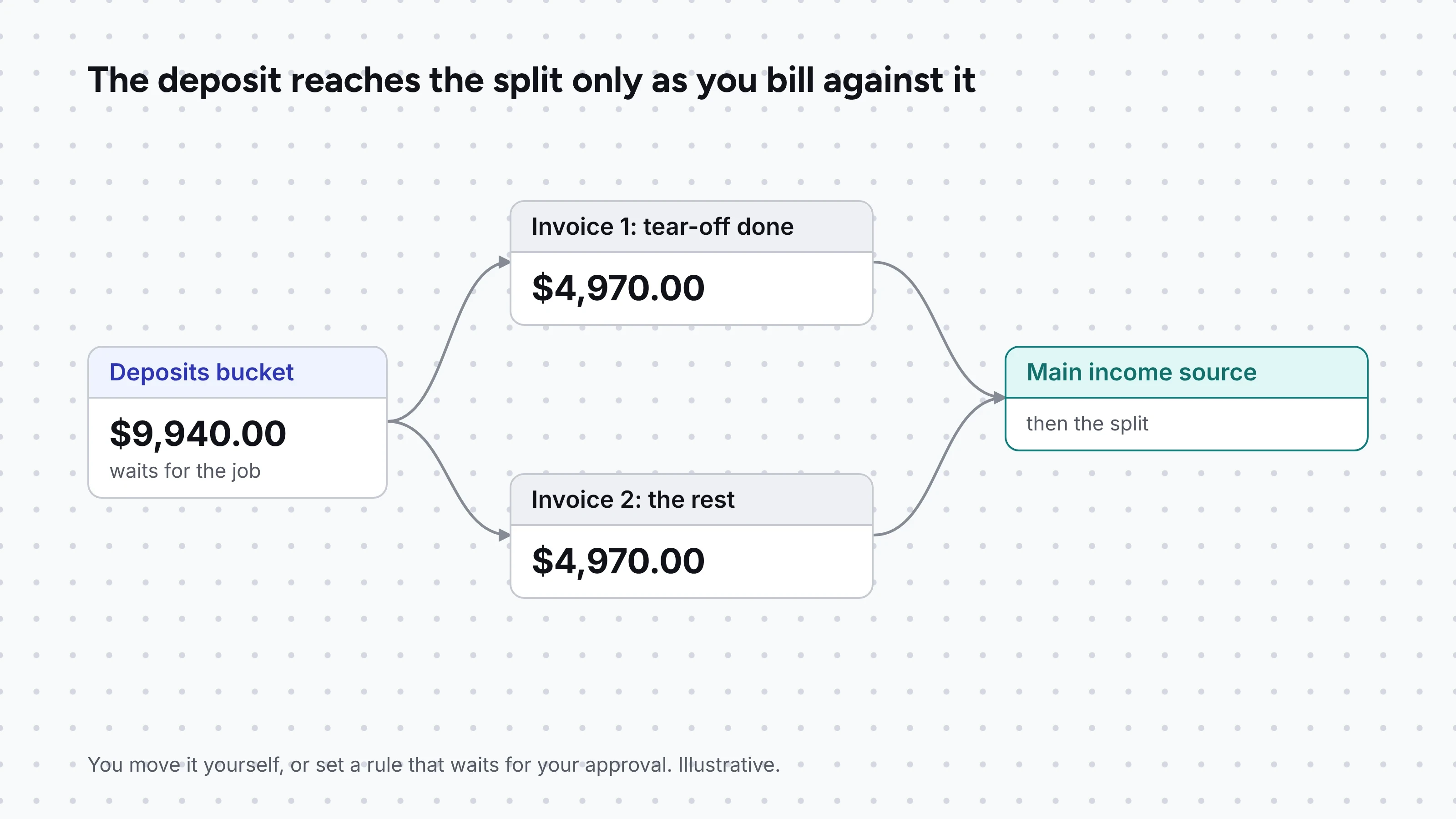
Let's say you bill the first $4,970 of the re-roof deposit once the tear-off is done. You move $4,970 from the deposits bucket to the main income source, and the split runs on it like any other payment. You can move it yourself, or set a rule that waits for your approval before it runs.
The painting company I mentioned in Step 1 does it another way: its project deposits account runs a split of its own, with a share going straight to materials. Either way, the deposit never pays you profit on work you haven't done.
How do you set aside sales tax when it isn't charged on every dollar?
Sales tax is the easiest bucket to set up and the hardest to get exactly right. Some owners keep it simple. One trade shop we set up runs its tax bucket as a flat 6% for sales tax. That works when every invoice is taxed the same way.
Contracting invoices often aren't. One HVAC owner we onboarded charges 6.5% sales tax on the whole invoice for some jobs and on only part of the invoice for others.
So the percentage rule gets you close, and a monthly true-up gets you right. Let's say your rule sends 6.5% of each payment to sales tax, and by month end the bucket holds $1,388.52. This month's invoices only owe $1,104.37, so you move the $284.15 difference back to operating.

Which lines are taxable, and at what rate, depends on your state and your trade. That's your accountant's call. Once you have the rate, the rule sets that share aside every time money lands.
Is it safe to point your Jobber payout somewhere new?
Re-pointing a payout is the step that makes owners nervous, and that's fair. Pointing your Jobber payout, or your QuickBooks payments, at Sequence means giving them the income source's account and routing number.
The income source doesn't keep the money. Your rules send everything that lands on to your buckets, and those can stay at the bank you already use, where the money arrives the same day by ACH.

Every move shows up in your activity record, and you can make any rule wait for your approval. If you're not ready to move a payer, leave it where it is and pull from that account instead, which takes 2 to 3 business days.
Where to start
Start with the second income source. Route the next deposit through it and watch your checking balance once deposits stop counting as revenue. What's left there is yours to spend. You can change any rule whenever you want. The Profit First map is the fastest place to begin, and our team will walk through a contractor setup with you.
FAQ
How many accounts does a contractor need for Profit First?
Profit First starts with four accounts: profit, owner's pay, taxes and operating expenses. Contractors add three more for money that isn't theirs yet: a deposits bucket, a sales tax bucket and a materials bucket.
Can my spouse or office manager see the accounts?
Yes. Add them as a viewer on your Sequence account.
Do permit fees count as revenue?
A reimbursed permit fee is the client paying you back, so owners keep it out of the split. How it's booked is a question for your accountant.
How is this different from the Profit First for Contractors book?
Shawn Van Dyke's book adapts Mike Michalowicz's method for construction businesses. This post covers running it: which money comes off the top, and how the split runs as payments land.
Can I split Jobber or QuickBooks payments automatically?
Yes. Point the payout at a Sequence income source, and your rules split each payment as it lands.