
Let's say Blue Cross Blue Shield pays you $1,847.36 on Thursday, and it covers ten clients from three different weeks. Your Stripe copays land on their own days. None of that adds up to a paycheck, and splitting it by hand every time a batch lands is where Profit First quietly stops.
You can fix this without calling a single insurer. They keep paying the account they pay today. Once a week, Sequence moves the money out of that account, leaving enough behind to cover the bills still paid from it. As soon as the money arrives in Sequence, it's split into your Profit First accounts. Your share builds up in its own account, and you get paid the same amount every other Friday.
I've helped solo clinicians and group practice owners set this up. One of those practices gets paid by dozens of insurers. The owner wasn't going to call a single one of them.
Why does Profit First stop working when insurance pays in batches?
Mike Michalowicz's Profit First splits your income into separate accounts before you spend it. Insurance money makes that hard to do by hand, for two reasons.
The first reason is that every batch is a different amount on a different day, so the split has to be worked out again every single time. The owner of a psychotherapy group practice told me all they see on a deposit is the payer: "I just see their name. It says Aetna, blah, blah, blah, and it says $1,000. I don't know what they're doing." A marriage and family therapist I set up, who runs a solo practice, described their income the same way: up and down, with no set paycheck.
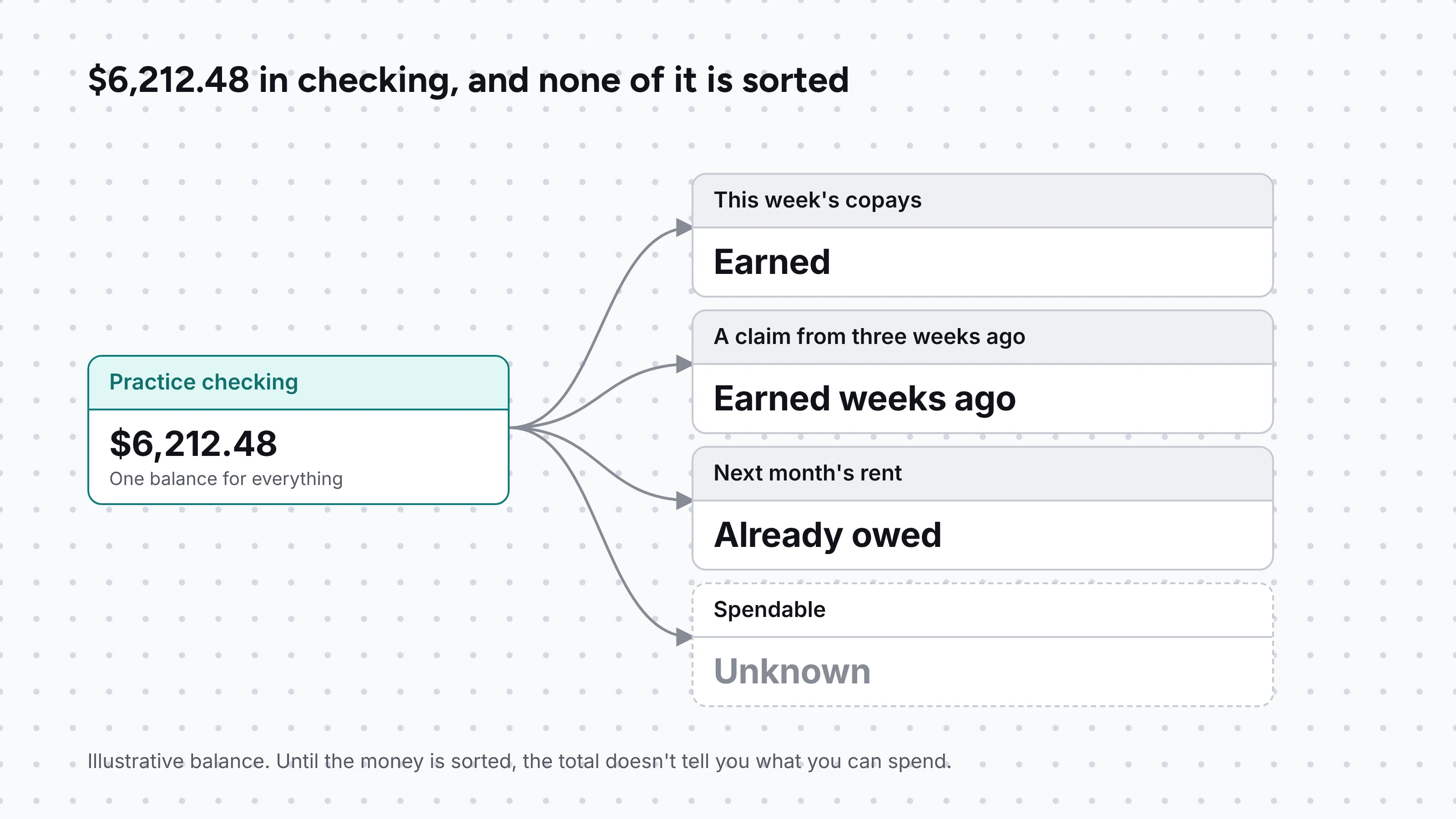
The second reason is that everything lands in one balance. Let's say $6,212.48 is sitting in checking: this week's copays, a claim from three weeks ago, and money you'll need for next month's rent. Until it's sorted, none of that number tells you what's spendable.
Julie Herres adapts the method for practice owners in Profit First for Therapists. The rest of this post is the part the book leaves to you: running it on insurance money automatically.
How do you run Profit First without changing your bank details with every insurer?
Most of the psychotherapy group's income came from insurers, dozens of them. When we set up the practice, the owner said it straight: "I have too many insurance companies." Changing where they paid would have meant calling every one of them and explaining why the practice's bank account had changed, so the owner wasn't going to re-route any of it.
They're right that it's a job. Each insurer pays by direct deposit into the account you registered with that insurer, and changing it means going through each one's own forms and verification. Your practice software can't do it for you either. SimplePractice says it and its clearinghouse play no part in moving money between payer and provider.
So the money has to keep landing where it lands today and still get split. You link the account your insurers already pay to Sequence, from any of the banks and credit unions Sequence supports. Then, once a week, a rule rounds that account down: it leaves a set floor in the account and moves everything above it into an income source. An income source is a feature in Sequence, an account with its own account and routing number where your split lives. The moment the money lands there, the split runs.

Behind the scenes, Sequence can see your current account's balance, but it can't see each deposit as it arrives there. That's why the rule runs on a set day, say every Tuesday, instead of on every payment. Money pulled in from another bank takes 2 to 3 business days to land, so Tuesday's sweep is split by Thursday or Friday. Anything due in the next three business days gets paid from money that's already in Sequence.
The floor is a cushion for whatever still comes out of that account before the next sweep. Let's say your office rent of $1,385 still autopays from it on the 1st, along with your practice software and your card processor's fees. Set the floor at $1,600 and none of those bounce while the rest moves on. Then move those bills over to your operating expenses account, so they're paid from the split like every other expense. Once they've moved, the floor only has to cover what's still clearing.
Copays and any insurer you move later work differently:
Copays through Stripe: point the Stripe payout at the income source, and copays split as they land.
Insurers you move later: move them one at a time, once you've watched the sweep run. On calls, that's what I see most often. People keep their payouts going to the account they know, and they move them once they trust the setup.
What happens if Social Security lands in your practice account?
The marriage and family therapist had five income sources, and only two of them were practice money. The five were their own Social Security, their spouse's Social Security, university teaching pay, insurance payments for the practice, and Stripe copays from clients. The insurance and the copays are the same practice, so on our call the tax step ran on those two only. The other three went into household money untouched.
The line between practice money and household money matters even more once a weekly sweep is pulling from an outside account. Sequence can't tell who put money into that account, so a sweep that rounds it down takes everything above the floor, Social Security included, and splits it like practice income. Keep practice money in a practice checking account and household money somewhere else. If your insurers pay into an account that also gets household deposits, that's the one case where moving them early is worth the calls.

In a group practice, insurance and copays are both practice money, and both go through the split. If you pay 1099 clinicians, ask your accountant whether their share counts as a subcontractor cost in Michalowicz's Real Revenue step, the adjustment where costs like subcontractors come off before the split.
How does a solo therapist get the same paycheck every two weeks?
Insurance pays in batches, so I'd set a solo practice up in two layers: the split runs on every deposit, and your paycheck runs on a calendar.
Let's say two weeks bring in $4,403.00 of practice money: $1,847.36 from Blue Cross Blue Shield, $1,012.50 from Aetna, $608.14 from a smaller plan and $935.00 in copays. Your split is 5% to profit, 45% to owner pay, 30% to operating expenses and 20% to taxes, the figure your accountant gave you. That sends $220.15 to profit, $1,981.35 to owner pay, $1,320.90 to operating expenses and $880.60 to taxes. I made those numbers up. The point is the shape.

The owner pay share doesn't go to you the day it lands. It builds up in an owner pay account, and a second rule pays you a fixed amount from it every other Friday. Pick that amount from what you make in an average two weeks, say $1,900. Some weeks the account runs high and some weeks low, and the paycheck stays $1,900. The account takes the swings so your personal checking doesn't have to. A therapy practice we work with runs a version of this: a $2,500 owner's draw, with 5% of it going on to personal savings.
"What if a payer is slow and the account is short on a Friday?" Set the paycheck rule to send up to that amount, and it sends what's there. If the account holds $1,736.42 that morning, $1,736.42 is what moves.
Your tax share builds up the same way, in a tax account of its own. The psychotherapy group owner wanted to pay estimated taxes straight from that account instead of routing the money back through checking, and you can: give the IRS the tax account's routing and account numbers. How much goes in is your accountant's call. What you gain is that the money is already sitting there when the payment is due.
How do you keep a group practice's payroll from coming up short?
A group practice adds payroll, and payroll is what worries group practice owners most. The psychotherapy group owner ran it every other week straight out of current income, and the worry was a rule moving money out before payroll did: "And I didn't realize that with all these rules, I pulled too much money to cover payroll. And then payroll tries to pull from the bank." A minute later they got to the answer themselves: "So that would almost be like a top-up, like I'm trying to prioritize it."
Payroll is an operating expense, so it comes out of the operating expenses share after the split. Give it an account of its own. Let's say payroll for three clinicians and a front desk runs $18,460.22 every other Friday. Every Monday, a rule tops the payroll account up to $18,500 from operating expenses. Then give Gusto (or ADP, or whoever runs your payroll) that account's routing and account numbers, and it pulls from there on payday.

If payroll swings because hours swing, set the target at your bigger payroll. The day after it runs, a rule sweeps whatever's left in the payroll account back to operating expenses.
"And if operating expenses can't cover it?" Then Profit First is telling you something: payroll is too big for the revenue right now. Fix it in the percentages or in the schedule. Don't pull it from profit.
Some owners I work with fund payroll before the split runs. That bends the book, and I'll make the case for it in an upcoming post on dental practices.
Your own pay runs the same way as the solo setup above: owner pay builds up, and a fixed amount goes out every other Friday. Your team's payday and yours both stay steady, whatever the insurers send that week.
What should you watch in your first two months?
For the first two months, watch three things: the paycheck, the percentages and the approvals.

The paycheck: if the owner pay account comes up short twice, lower the paycheck. If the account keeps piling up past a couple of paychecks, raise it.
The percentages: they'll be a little off at first, and that's normal. Leave some cushion in operating expenses while you learn how your batches actually run, then tune the split after one or two cycles.
The approvals: you choose which moves run without you and which wait for you. For the first few Fridays, approve the paycheck before it goes out. A clinic owner I spoke with checked the accounts late one night, found several withdrawals that looked like percentages of something, and couldn't say what they were for. With approvals on, you see each move before it happens.
After that, the rules you set do the moving, and you adjust them as the practice changes. You can change any rule whenever you want. If you'd like help mapping your insurers and copays onto this, book an onboarding call and we'll walk through your setup with you.
FAQ
Do I have to change my bank details with every insurer to use Profit First?
No. Your insurers keep paying the account they pay today. A weekly rule rounds that account down to a floor and moves the rest into Sequence, where it lands 2 to 3 business days later and the split runs. Moving an insurer later is a change you make with that insurer directly.
Can my practice software send insurance money to Sequence?
No. Insurers deposit straight into the account you registered with them, and SimplePractice says it and its clearinghouse aren't part of that transfer. Copays collected through Stripe are different: point the Stripe payout at your income source.
How much should a therapist set aside for taxes?
That number comes from your accountant, based on your income and your estimated payments. Sequence holds it for you: a tax account gets its share of every practice deposit, and you can pay quarterly estimates straight from it.
How do I pay myself a steady salary from insurance payments?
Let the owner pay share of every deposit build up in its own account, and pay yourself a fixed amount from it every other Friday. Pick the amount from what you make in an average two weeks. The account takes the high and low weeks, and your paycheck stays the same.
Will my bookkeeper have to sort through every transfer?
Not if the sweep runs weekly. That's one transfer a week instead of one per batch, so your bookkeeper isn't tagging a transfer for every insurance payment. Have your bookkeeper track the income source for income, and add the other accounts to QuickBooks with their routing and account numbers like any other account.
Is there a Profit First book for therapists?
Yes. Julie Herres's Profit First for Therapists (2023) adapts Mike Michalowicz's method for private practice owners, from solo clinicians to group practices. This post covers the automation side.